Emberfold
A cosy-dark idle game for the browser: build a home around an ember, and come back to see what happened.
At a glance
- Status
- Free to play on a phone or a computer, no account needed. Still growing.
- Built by
- Jhune Bryan Reyes
- Started
- 2026
- Languages
- English, Dutch, French
What it is
Emberfold is an idle role-playing game that runs in the browser: nothing to install. You wake up with no memory next to an ember that never goes out. You give yourself a name, a face and a past, gather a small party, and before you close the tab you give everyone a job: go out to one of the zones, guard the home, build, or rest. While you’re away, trips and builds carry on and the garden grows. When you come back, the game works out from the clock what happened: what was found, how the night’s attack went, someone new by the fire, and one line from the Ember.
Why we built it
We wanted a game for a few spare minutes on a phone: choose what everyone does, put the phone away, and look forward to coming back. Many idle games are walls of numbers that keep ticking. We wanted a small world with a story, warm by default, where nobody dies unless you choose to play Grim, and where closing the tab is part of playing. It was also a chance to build a game with the same care as Guestbloom: in three languages, accessible, and fast on a cheap phone.
On a phone
Emberfold on a phone, light and dark.
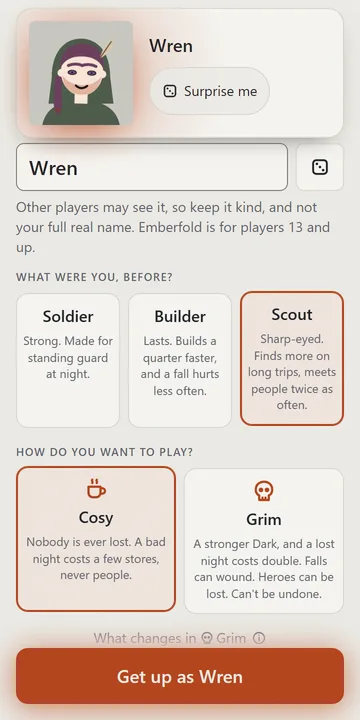
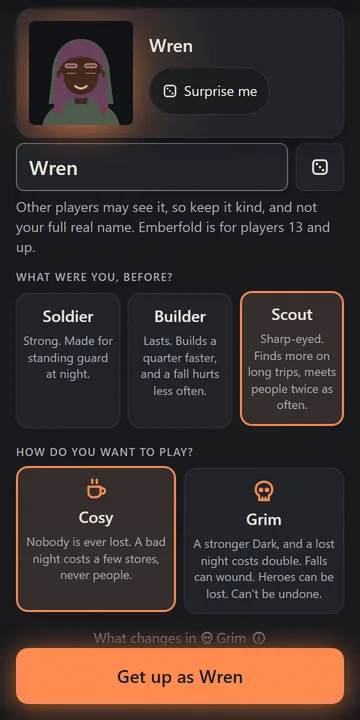
Waking up: a name, a face, what you were before, and Cosy or Grim 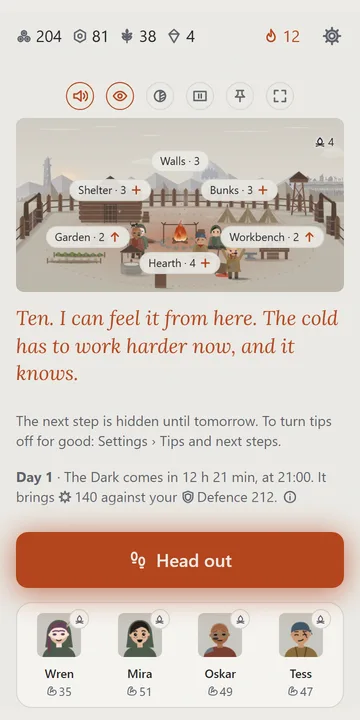
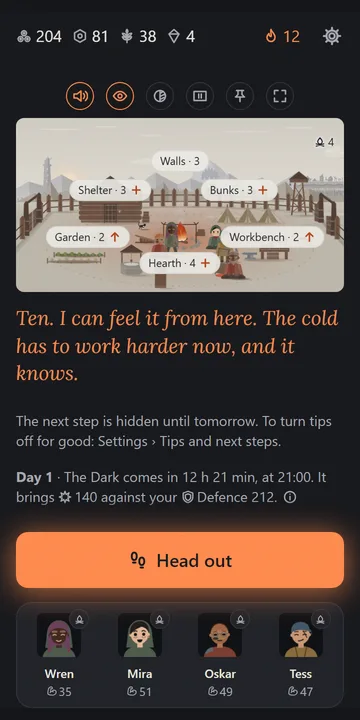
Home: the camp around the Ember, and the party by the fire 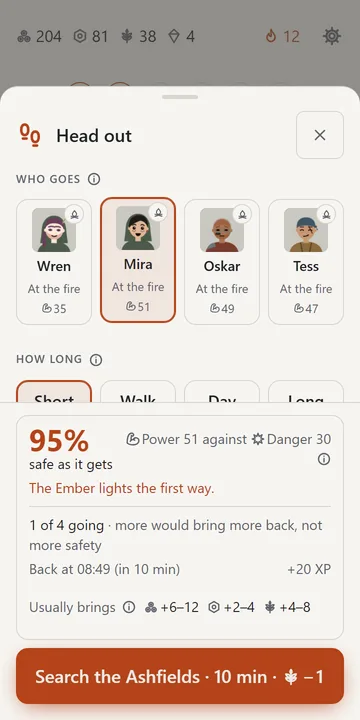
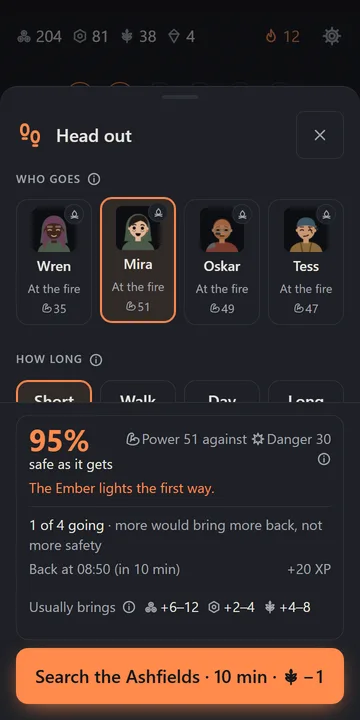
Heading out: who goes, for how long, and the odds 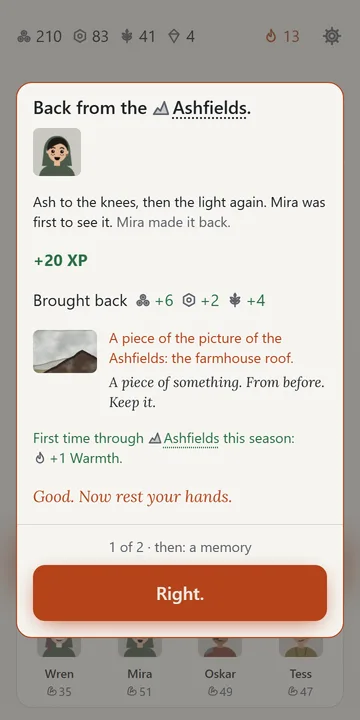
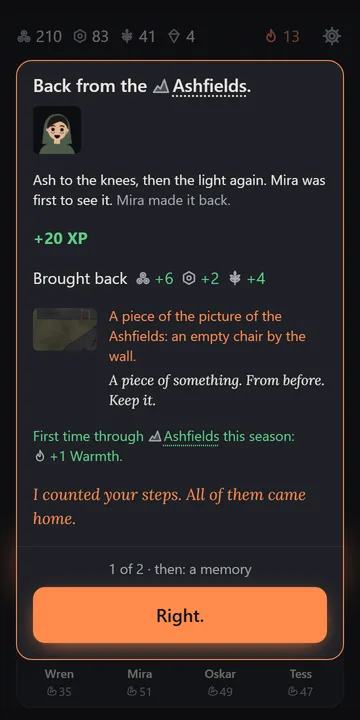
Coming back: what happened while you were away
What it does
A party you gather
Up to three companions join you. Some walk in from the ash and stay; others fight for pay and move on.
Made for closing the tab
Trips, builds and the garden carry on while you’re gone. When you come back, the game works out what happened and shows it one moment at a time.
Watch them out there
While anyone is out, tap their trip to watch it live, in its own place: the Ashfields, the Flooded Street on a raft, the Dead Wood, the Hollow Tower and the Maw. Each place has its own creatures, a leader, weather and music. Every creature has hit points that go down blow by blow, and what stands in the way breaks like wood, stone, metal or glass.
A home that grows
A Hearth, a Shelter, Walls, Bunks, a Workbench and a Garden around the Ember, each with parts to add, like a Gate or a Beehive. Everything you build shows in the scene.
Cosy or Grim
In Cosy, nobody dies. Grim is a harder way to play, and only if you choose it: a wounded hero who falls again is gone for good, and a stone by the fire keeps the name.
A story, one line at a time
The Ember never explains. It says one line when you come back, and each day it asks for one small thing you can do.
Seasons
The Long Night takes the buildings, the gear and the stores. You keep the Ember, your heroes, your pets, the Shelf and your Warmth, and a new season begins.
A Shelf, and a fire to share
The Shelf keeps what you’ve earned for good: goals, every place you reached, every creature you fought and each place’s leader, and old pictures you piece back together. Share a link to your fire, and after your first Long Night, see it among the other fires out in the dark.
How it’s built
Built with
- Next.js
- TypeScript
- Supabase
- PostgreSQL
- Tailwind CSS
- PixiJS
- Playwright
- Sentry
- GitHub
- Vercel
- Resend
- Claude Code
- Built by JB with Claude Code, an AI assistant. JB decides what the game is and plays every change on a real phone; Claude writes much of the code and the tests.
- The game’s rules run inside the database, so nobody can give themselves more Wood from the browser. Tests check that the database and the app agree on every rule.
- Before there was a single screen, a simulator played whole seasons as four kinds of player, to tune the numbers.
- Every change is tested automatically on an Android phone, an iPhone and a computer screen, accessibility included.
- The camp and the trips are drawn with PixiJS on the phone’s graphics chip, so it stays smooth with the weather, the light and a whole camp moving. Menus and sheets stay plain HTML. If a phone takes the chip away, a still picture stands in. The drawing loads after the page, so the first download stays small.
- A trip’s picture is worked out from the trip and the clock alone, so every device shows the same moment, and opening it halfway lands in the middle of the fight. Only how it ends comes from the server.
- The browser makes the sounds and the music itself, so there are no sound files to download.
- The data stays in the EU (Frankfurt).
What we learned
Play it in numbers first
The simulator found seven problems with the numbers before anyone had played a single minute.
One world, not three tabs
The first version had three tabs of forms, and building something meant scrolling three screens down. Now everything happens in the scene: tap a building, and a sheet slides up.
Measure before you rebuild
The scene began as one big SVG drawing. The more moved in it, the more the phone had to redraw all of it, every frame: 7 frames a second on an iPhone. Measuring showed where the time went, so the picture moved to PixiJS, which draws on the graphics chip: 59 frames a second on the same phone.
Kind beats harsh
In Cosy, nobody dies: if you fall, you wake up by the Ember again and still bring home a quarter of what you found. Losing a little feels fair, and it brings you back. Players who want it harder can choose Grim.